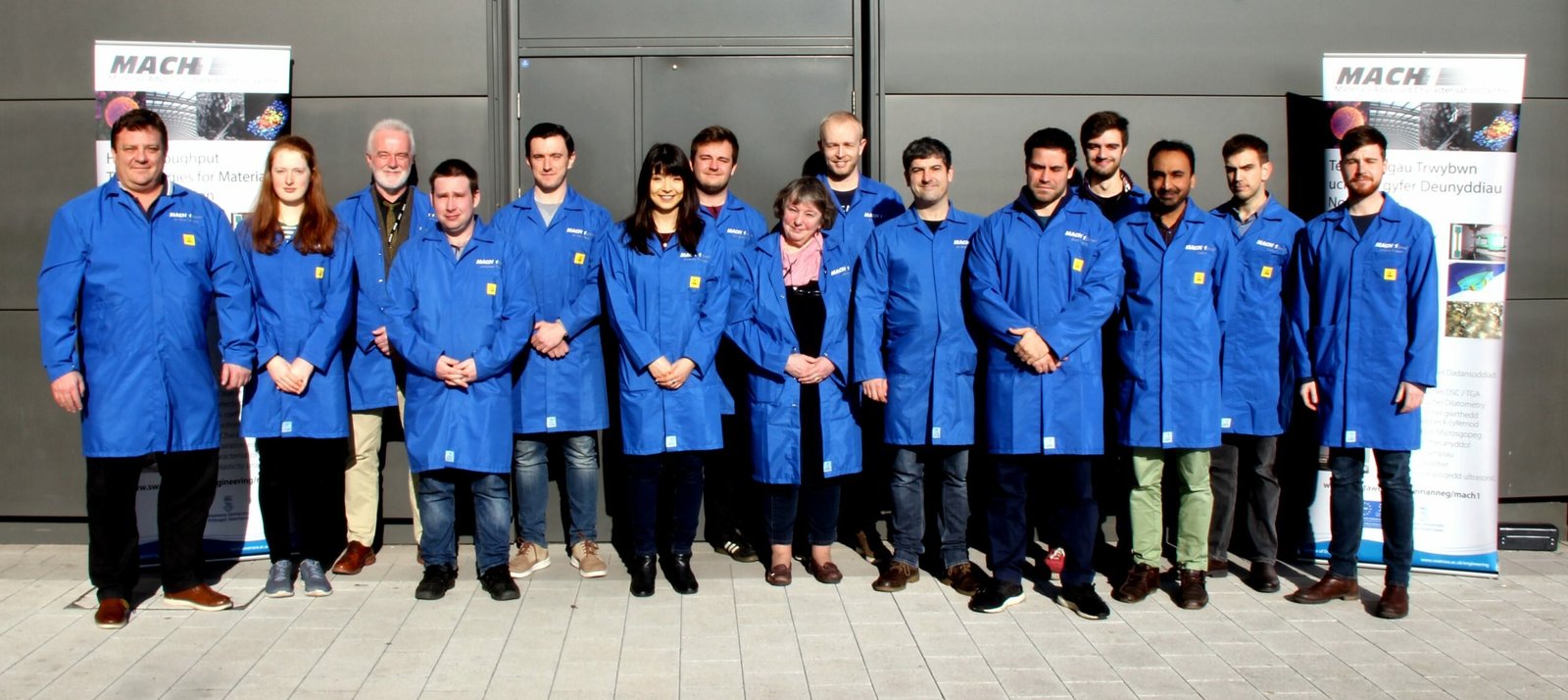
In 2013, in collaboration with Professors Steve Brown, Cameron Pleydell-Pearce and Johann Sienz, we were fortunate in securing funding from the Welsh Government’s Academic for Business funds to set-up equipment for the MACH1 laboratories at Swansea University to undertake Rapid Alloy Prototyping, high throughput Materials Characterisation and Additive Layer Manufacturing (ALM Labs), with the long-term vision of becoming a centre of international excellence for metallurgical research in South Wales.
Swansea University was founded on the metallurgical expertise in South Wales, and as the University most recently marked its centenary, metals remain an important part of our economy. Important projects which come about because of MACH1 include the Welsh Government funded project COMET (COMbinatorial METallurgy), closely followed on by the EPSRC funded project PROSPERITY, acknowledging a renaissance in accelerated metallurgy for the discovery of new alloys, lighter, stronger, more durable and, critically, more environmentally sustainable in manufacturing, and more environmentally benign in use. It is a testament to the relevance of our research that all the projects are strongly led by industrial partners (for example: Tata, Sandvik-Osprey, Kennametal, Renishaw) with bases or strong links to South Wales.
This research and these projects have led to well-equipped laboratories comprising almost 200 square metres within IMPACT, as well as a stream of collaborative PhD and EngD projects with organisations such as Renishaw, Tata, ESI, Qioptiq, and DSTL. This means that at any one time, there are over 17 PGR/PDRA researchers working in the team loosely under the umbrella of MACH1. The general nature of the capabilities in these labs means that we have excellent internal collaborations between Swansea academics and research groups/projects such as SPECIFIC Corrosion (Prof Jim Sullivan, Dr Natalie Wint), AIM Microscopy (Prof Cameron Pleydell-Pearce and Prof Richard Johnston), M2A (Prof Dave Penney), ASTUTE (Prof Johann Sienz), FMRI (Dr Will Harrison, Dr Andrew Rees, Prof Sondipon Adhikari, Prof Serena Margadonna) and ISM (Dr Rob Lancaster).
Projects undertaken in MACH1/ALM Labs
Of course, none of this can be done alone, and foremost in running the labs is Dr Shahin Mehraban, who currently leads the £1.4M Welsh-Government COMET project as project manager with assistance from Catherine Singleton, coordinating inputs from the stakeholders including WG and collaborating companies (Tata, Sandvik-Osprey, Renishaw, Kennametal, Lase, ESI and DSTL) as well as technically managing most of the laboratory day-to-day work. Shahin has been part of MACH1 since its conception when we were still on Singleton Campus. Shahin supervises a team of three research assistants on COMET, Dr Steve Milward (Additive Manufacturing), Dr Jonathan Cullen (Rapid Alloy Prototyping) and Dr Davi Ramos (Computational Modelling). Working alongside them is Professor Monique Calvo-Dahlborg helping on the selection and development of new High Entropy Alloys. Also assisting on COMET some modelling aspects of LPBF in the COMET project is Jordan Rosser, who is undertaking his EngD sponsored by ESI. You will be hearing a lot the COMET over the coming articles, as it is making many contributions and new discoveries of potentially high IMPACT.
On the EPSRC PROSPERITY project led by Professor Steve Brown, the project directly employs two PDRAs, Dr Mazher Yar and Dr Lintao Zhang working on Rapid Alloy Prototyping of a new generation of steels for Tata. The PROSPERITY project is a 3-way collaboration between Swansea, Warwick University and Tata steel looking to use small scale Rapid Alloy Prototyping (RAP) routes for new alloy development within the SU MACH1 laboratories. Also working on PROSPERITY work is Caroline Norrish who is working on using RAP to investigate the effect of residual elements on a range of Tata steels, which will contribute towards a better understanding of the recyclability limits of scrap steel in the industrial process. This project has had a significant contribution for new equipment from the IMPACT project funding for a new hot rolling mill and a high-speed digital camera
Another recent project to mention is the Innovate UK project with the bike lock manufacturer Zeal which has seen an additional 3D metal printing equipment on loan from the company for the next 18 months. Currently appointed to this project is Dan Butcher, who has undertaken his EngD sponsored by Renishaw. This project will have a short blog of its own over the coming weeks.
It is not possible to elaborate on all the projects on which all the laboratory users in MACH1 are funded, or indeed all the end user companies, suffice to say that the broad of scope of equipment is ideally suited to research in metallurgy and manufacturing is leading to ever increasing close interaction between the University and industry.


